 On July 8, I spent an afternoon in Bushwick with James Rojas. An urban planner by training, Rojas uses a very interesting method to observe how people “feel” their cities as they currently exist, and how they can imagine an ideal version of their urban spaces. “The idea is just to give them some material and see how they imagine their ideal city through such material” James explained to me. They do not need to speak during the activity or write in order to explain what they imagine and want. Rojas’ workshop provided an experiential exercise that fills the language gaps in this multicultural city.
James, a quiet person who was born in California as part of a second generation of Latino immigrants, has few words to say in English and even fewer in Spanish, but understands all of what I said in the same language. In the end, what I can notice is a man with a blue bag full of pieces of old toys (hair rollers, little animals, little trees, etc) and a brain full of memories of the city where he has grown up: Los Angeles.
He told me that this workshop indeed stems from such ideas and the Mexican culture that is very present in that part of California. He mentioned that he has observed many times the typical Nativity in some of the ideal cities built up by the people there, as well as the mixture of the culture in LA, a Christmas tree decorated with Mexican typical handcraft. We could notice the same in this workshop when a little girl put some figures proper to her city of origin and mixed this with some snowflakes. Rojas has conducted the workshop around the entire country and last Thursday, Rojas workshopped with adults in Midtown Manhattan. But like he says, other cities and other states will then get their turn next.
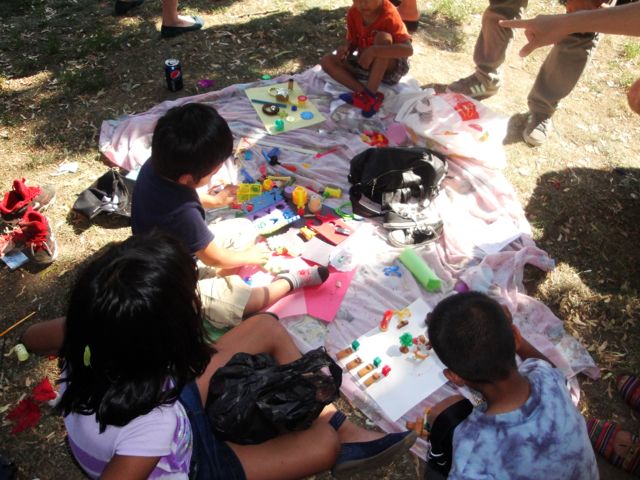
In this case James did the activity with children in Maria Hernandez Park in Bushwick, Brooklyn. Most of them were Latino and younger than six years old. It did not take more than four minutes to hook the children’s attention after James placed the big blue IKEA bag full of toys and “things” on the soil–a colorful scenario that a child cannot resist. Even though the day was extremely hot and the park looked more like an arid desert with a few green bushes, the approximately twenty children were really concentrated on their dream: building their own ideal cities. Even when a few of them lost focus on the activity, what really happened is that most of the children just sat there and followed a simple and basic instruction: “build up your ideal city.”
We took out some papers and sheets so they could “plan” their cities over a more solid foundation than the soil. Twenty minutes later, they had completed their own cities with the “things” that they found in the bag. Opposed to what some of us might think, the children had great stories behind their spontaneous experience. They were not just playing with the objects and if they were; they played to be the ideal engineers and the ideal architects. Almost every single piece was put over the paper sheet with careful intention, and had its function and its order. But mainly, every piece had a story that they developed in their heads and told us after playing with the objects for twenty minutes. As for James, that story is the result of a life they have seen, heard, smelled, tasted but mainly felt. Evidence of a life that maybe did not start there in Brooklyn–or a life that was began in the city but still has some of their parents’ roots—materialize in a mix of their home cities and their current one. At least that is what we saw in their “ideal plans”–plans that most of the time were full of color, water, farms, animals, and faith.
According to James, the exercise is a great way to see how people feel their city. But it is also an activity that allowed us, the viewers, to see how those who participate, have their culture inside and how they reproduce such culture in a scale model.
Now that the activity is over, I hope that next time, instead of dried soil into the IKEA blue bag, James will find some green bush along his pieces of toys reflecting the dreams of the children and the reality of a greener city. And I also hope that children but also adults (Rojas’s second workshop in NYC consisted of the same activity, but for adults) can keep their cultural roots in their ideal cities but with a more global idea of world citizen of a greener city.

El pasado 8 de Julio pasé toda la tarde en Bushwick con James Rojas. Un urbanista que utiliza un método bastante interesante para observar la forma en que la gente “siente” la ciudad que habita y la forma como imaginan una ciudad ideal. “La idea es simplemente darles algún material y ver como ellos imaginan su ciudad ideal utilizando ese material” me explica James. Ellos no necesitan hablar o escribir durante la actividad para explicar lo que imaginan o desean. El taller es un ejercicio experiencial que cruza la frontera del language en una ciudad multicultural.
James, una persona callada que nació en California como parte de una segunda generación de inmigrantes latinos, tiene pocas palabras en inglés para decir y todavía más pocas en español. Sin embargo, el entendió todo lo que le dije en este idioma. Al final, lo que puedo ver en James es a un hombre con una bolsa azul, llena de pequeños juguetes o trozos de ello (rulos para el pelo, animalitos, arbolitos, etc) y un cerebro lleno de memorias de Los Angeles, la ciudad en la que el creció.
De hecho, el me comentó que este taller tiene su origen en esas ideas y la atracción que siente por la cultura mejicana que esta bastante presente en California. El menciona haber visto varias veces las típicas Natividades en los prototipos de ciudades ideales diseñadas en esa ciudad, así como la mezcla de culturas presente en Los Angeles. Un árbol de navidad decorado con piezas de artesanía mejicana por ejemplo. Algo similar a lo que pudimos ver en el taller de hoy cuando una pequeña puso figurines típicos de su ciudad natal junto con algunos copos de nieve que seguramente ha visto acá en Estados Unidos.
Rojas ha conducido dicho taller por todo el país con gente de todas las edades. El siguiente se realizará mañana en el centro de Manhattan con adultos. Pero como el dijo, luego vendrá el turno paran otras ciudades y otros estados.
En este caso, James realizó la actividad en el parque María Hernández en Bushwick, Brooklyn. La mayoría de los participantes eran niños latinos menores de seis años. Después de que James dejara la bolsa en el suelo, no pasaron cinco minutos para que los niños se acercaran con toda la atención puesta en la bolsa azul de IKEA. Una bolsa llena de juguetes y “cositas”. Un escenario bastante colorido para que un niño se resista a acercarse. Y aún cuando algunos de ellos habrían podido perder la concentración, lo que realmente sucedió es que la mayoría simplemente se mantuvieron allí sentados siguiendo la dirección dada: “construir sus ciudades ideales”.
Nosotros les dimos unas hojas de papel para que pudieran planear sus ciudades sobre un suelo un poco más solido que el suelo del parque. Veinte minutes después, ellos habían terminado sus diseños con las “cosas” que encontraron en la bolsa. Opuesto a lo que muchos de nosotros podríamos pensar, los niños tenían grandes historias apoyando sus bocetos. Ellos no estaban simplemente “jugando”, y si lo estaban haciendo, entonces jugaron a ser los ingenieros y los arquitectos ideales. Casi todas las piezas estaban puestas intencionalmente con un orden y una función específica. Y aun más, cada pieza tenía una historia que ellos desarrollaron en sus cabezas y que nos contaron luego de jugar con los objetos por veinte minutos. Según James, esas historias son el resultado de una vida que ellos han visto, oído, olido, probado y principalmente sentido. Historias de una vida que quizás no empezaron allí en Brooklyn, o que empezaron en la ciudad pero aún conservan algo de las raíces natales de sus padres, y que se ha materializado en una mezcla de sus ciudades de origen y su ciudad actual. Por lo menos, eso es lo que vimos en sus planes ideales. Planes que estaban llenos de color, agua, granjas, animales y fe.
Según James, el ejercicio es una forma excelente para ver cómo la gente “siente” sus ciudades. Pero tambien una actividad que nos permitió a nosotros, los que observamos, ver cómo los que participan llevan dentro sus culturas y las reproducen en modelos a escala.
Ahora que la actividad se ha acabado, yo espero que en lugar de tierra seca, la próxima vez, James encuentre en su bolsa de Ikea no sólo sus juguetes, sino algo de pasto verde. Algo que refleja los sueños de los niños y la realidad de una ciudad más respirable. También espero que los niños y los adultos (quienes serán los participantes del siguiente taller de Rojas) puedan mantener sus raíces culturales en esos imaginarios de ciudad ideal pero con una idea más global de lo que implica ser un ciudadano de un mundo más verde.