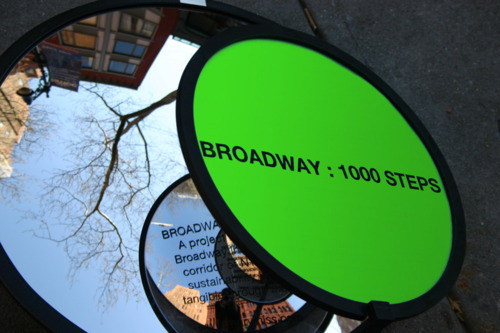
 If sustainable change–new technology, environmental planning, greener design–is going to impact the world, we need more than innovative ideas, we need equally innovative ways of sharing them with each other. “Meeting Environmental Challenges with Art in the Public Sphere,” a panel on June 5th at CUNY’s Institute for Sustainable Cities, explored how art and science can support each other and can both actively engage the public to create awareness, discourse, and hopefully coalesce in meaningful change. The assembled panel addressed these challenging questions through the lens of Mary Miss/City as Living Laboratory’s Broadway: 1000 Steps, an art installation currently in development which affords New Yorkers the opportunity to reimagine their immediate environment. Slated for spring 2013 implementation, the project will run the length of Broadway and highlight natural and human landscape elements of which passersby would have been previously unaware. Installation elements reflect elements of Bloomberg’s PlaNYC (including air, water, land and energy) and encourage viewers to consider their surroundings in new ways, such as mirrors and signage to draw attention to bird flight patterns and bright borders on storm drains to draw attention to waste water management. Diagrams on pavement and even complementary smartphone apps provide multiple visual elements by which participants in the installation can start to conceptualizer their surroundings as defined by more than concrete and street signs.
Before the panelists, representing all corners of the art world, began their dialogue, Mary Miss offered her thoughts on the interplay between art and science, specifically science with actionable social and environmental elements, and the reasoning behind Broadway: 1000 Steps. Attendees listened to Miss’ contemplatively eloquent remarks with the reverence of aficionados at a poetry reading. Her project was born when she asked herself, “how can artists of our time engage the public sphere, make issues of sustainability tangible, especially those that go the most unnoticed?” Miss’s installation aims transition viewers from imagining to enacting. Her work gives viewers the tools to build new mental maps of their own communities, ones not governed by the arbitrary cross sections of Real Estate. Miss envisions a near future where maps are not merely 2D representations of place to be hung on walls or folded in pockets, but rather as malleable, three-dimensional conceptualizations of our world. Miss mused on the “grammar of a map with peelable layers,” one where every person would be a part of the patterns represented. Miss believes that art should make sustainability tangible and give the public the tools to participate in “circuits of connection and thinking.” She knows that change happens not when mandated by “directives from above,” but when individuals understand that the changes they make will affect the greater systems in which they live.
Curator and critic Niels van Tomme opened the panel sequence and sparked a later debate by introducing the idea of the “extradisciplinary versus the interdisciplinary,” artistic work that exists outside the confines of traditional discrete artistic disciplines. He reminded the audience that “the potential of art is to imagine ‘what if,’ not just ‘what is.’” When art enters into the discussion he argues that it should be as a reminder of the infinite improbability of the non-existing. And yet, in his closing remarks of what was as rich as a full academic lecture on the theory of art in the modern world, he left us with the reminder that the stakes should never be so high that art becomes only a means.
Patricia Phillips (Dean of Graduate Studies at RISD) and art critic Eleanor Heartney addressed the political side of sustainability and art, citing public “guerilla” art projects that strove to demand chance of political agents, such as Mel Chin’s “Fundred” project in which school children decorate 3 million $100 bills for eventual submission to the government to represent the $100 million necessary to keep all New Orleans soil lead-free and safe for kids.
This raised the question, which would be re-tackled all evening, of whether art can actually encourage meaningful change, or can just make people think meaningful thoughts about change.
One example of an art installation that does directly contribute to improving environments and communities is the Bronx River Alliance’s Rocking the Boat, an eloquently cyclical public art project funded by Governor Cuomo’s collection of fines collected from EPA violations to create a wetland park in the South Bronx that filters the toxic runoff from (the supposedly uber-sustainable) ABC Carpet factory.
The closing panelist was Tom Finkelpearl, acting director of the Queens Museum of Art in the diverse immigrant community of Corona. He is of the persuasion that art can make a difference. He sees art as an endless and perfect opportunity to cross the language and cultural barriers the recent immigrants experience. Only after offering Photoshop, design and computer classes in Spanish, Mandarin and other languages of recent immigrants did Finkelpearl see those communities coming to the museum with their families to attend other programs and exhibits. According to Finkelpearl, people “vote with their feet,” if and when they find museum programs that are relevant to their lives. He argues that “English is not the only thing to teach immigrants,” and has firsthand experience of increased attendance from various immigrant communities right in Corona once they felt the museum reflected programs they wanted and needed. Once the space became partly theirs, once they felt some ownership of it and it stopped being merely the space of an ‘other’ which they could visit, they started coming to spend time truly enjoying and exploring in ways they never previously would have.
The floor was opened to the audience for questions, and one that many audience members reiterated was the query of whether or not art can actually make a difference, or if the art is more effectively used to communicate the ideas behind sustainable science. In an evening in which the tone oscillated between one of a poetry reading, an academic lecture and a political rally, the audience (and panelists) left asking themselves the questions that will be the most crucial ones to consider as we press forward into a time in which the way we process the sheer volume of data surrounding both the dire and the optimistic aspects of the sustainability will directly determine our success in sustaining the communities of the world.
Photo: MM/CaLL