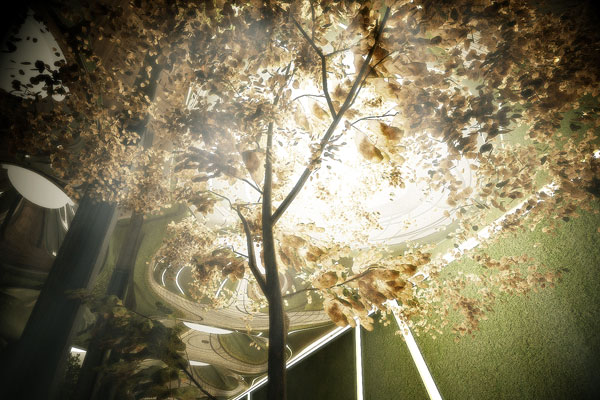
 There is a recent update to the Delancey Underground project, also known as the LowLine: a proposal to turn an abandoned trolley terminal into a public park below Delancey and Essex streets on Manhattan’s Lower East Side. Back in February, we covered this project when it was in its conceptual stage, but since then much has changed. The project just won support from Manhattan’s Community Board 3 after a presentation by Daniel Barasch, one of the LowLine project’s co-founders.
After a successful fundraising campaign on Kickstarter, the project has raised over $150,000 to build a full size installation of its solar technology to generate further support from the community, potential funders, and the city government. They plan to install the mockup in the Essex Street Market, an indoor public space. Their next fundraising goal is sponsored by an anonymous donor who offered to contribute $75,000 if that amount can be matched by other donations by August 15. These additional funds would go towards further research and feasibility studies.
If this project comes to fruition, it will be the first of its kind: a subterranean park complete with solar technology providing natural sunlight able to grow grass and trees, and year-long recreation space. James Ramsey, the other co-founder of the project and principal of RAAD Studios, has developed what he calls “remote skylight technology”, as shown below.  In an article in the New York Times, Ramsey explains that sunlight is captured above-ground in metal collectors, and the energy is transferred through fiber-optic cables, then distributed underground. The distributors, embedded in the ceiling, would essentially function as superbright light fixtures. If this new technology can be implemented on a large scale, in addition to funding and government approval, this unique urban renewal project would allow members of the immediate community and beyond to think about public space and reuse in ways never before imagined.
Photo: Raad Studio