Corresponding to the advent of the Olympic Games in London, the Storefront for Art and Architecture has created a “Post-Olympic city” exhibition displaying the work of photographer Jon Pack and filmmaker Gary Hustwit. Pack and Hustwit are working to document the legacy of the Olympic Games in a variety of host cities, using photography, video, and memorabilia. So far, the duo has documented the Games in Athens, Barcelona, Mexico City, Los Angeles, Montreal, Lake Placid, Rome, and Sarajevo; and they plan on visiting Beijing, Moscow, Berlin, and London. They are currently compiling their work in a book that will be available in the spring of 2013. On August 14th , the Storefront hosted an event where the artists and a group of knowledgeable panelists discussed the effects of the Olympics on host cities once the Closing Ceremony is over. 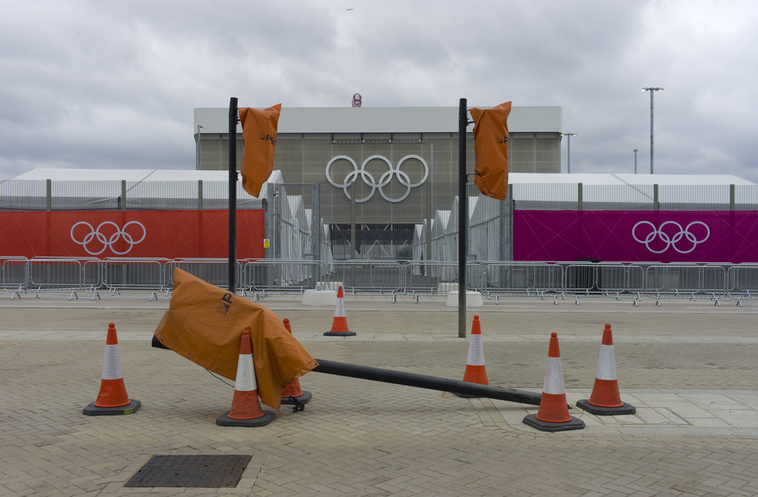
The panelists and the audience discussed the cases where host cities were able to create sustainable infrastructure— and the cases where cities spent billions just to dismantle everything they had spent billions to build. Mexico City is an example of a city that benefited from the ’68 Olympics, tripling in size and, significantly, continues to use the stadiums it constructed. It’s universally considered an honor to host Olympics, but that is not the only reason cities bid for the Olympics. They often receive federal money and sponsorship to help build infrastructure, such as subway systems and parks. Additionally, the tourism helps local businesses immensely. The conversation took an interesting turn when Gary Hustwit asked the question, “What cities need this development?” He pointed out that Los Angeles hosted the Olympics in 1984, and did not need to build anything new— so the city made a lot of money off of the Games. He said, “Now you cannot tell that it ever hosted the Olympics, but maybe that is the sign of success.” London, on the other hand, plans to keep only 6 out of the 22 venues that were just built.
One member of the audience brought up the fact that often cities try to improve their image by cleaning up shanty towns and displacing people without having a sustainable plan for relocation. The fact that so much is done without including citizens in the discussion can create ethical problems. The artists’ work contributes to the existing interesting debate about the positive, as well as negative, legacies of the Olympic Games.
Unfortunately, the exhibit has closed, but click here if you want to see what the Storefront for Art and Architecture has coming up. Have thoughts on an Olympic Legacy, whether good or bad? Tweet at us @cityatlas.