 Could diversifying New York’s economy be a deep way to both address urban success and environmental well-being? Three recent essays and a book by a New York writer all call attention to New York’s special qualities as a model for both economic life, and the future of life on the planet.
In the spring issue of the conservative-leaning magazine City Journal, Harvard professor of economics Edward L. Glaeser contends that New York’s economy has become increasingly dependent on the finance industry. This decline in industrial diversity threatens the state’s long-term economic growth.
Glaeser calls on Jane Jacobs’ 1970 book The Economy of Cities to illustrate that industries provide one another with the building blocks needed to generate novel ideas. This sort of piggy-backing of resources has resulted in innovations such as nighttime baseball, which merges baseball with electric lighting. A city with a more diverse selection of occupations therefore stimulates “more leaps of insight.”
The numbers support this reasoning: according to Glaeser, in 2008, workers in the finance and insurance industries earned 44 percent of Manhattan’s payroll; from 2008 – 2009, the city’s payroll plummeted $35 billion, with more than four-fifth of that decline stemming from those two industries. After studying 200 metropolitan areas between 1977 and today, Glaser further found that greater industrial concentration has an adverse impact on both population and income growth. Think of cities such as Detroit, and maybe, he warns, the Silicon Valley in a less luminous future.
As such, the Harvard professor concludes that New York’s support of industrial diversity with initiatives such as the Roosevelt Island investment is a “wise gamble.”
***
Glaser’s study is particularly significant in light of the disparity of wealth in the city that has made it difficult for a less economically viable, younger generation–professionals who could contribute to the state’s industrial diversity–to find a foothold in the city.
The expensive, single-industry city that Glaeser describes is the one that Malu Byrne is running from.
“Many of my friends who are artists find menial freelance jobs during the year so that they can afford to escape in the summertime to recharge their creativity,” wrote Byrne in her article “Running from the City.” “Not everyone succeeds with this kind of strategy, which doesn’t seem viable or long-term, especially if you don’t have the freedom of freelance work and are tied to a 9 to 5 job.”
For a young and undiscovered artist, “the notion of ‘making it in the city’ is increasingly nostalgic and impossible…Yes, the city supports the arts, but not its up-and-coming artists.” Byrne is the daughter of Talking Heads frontman David Byrne, and the The New York Times published the Byrnes’s side by side essays on the future of New York on May 26, 2012.
The tightening pressures of living in the city, Malu Byrne points out, have forced some struggling artists to dream of a retreat to the countryside. Rising rent, the scarcity of other living amenities in combination with a sort of romantic nostalgia for a life filled with the sweetness of fresh air rather than the “chaos of city life” have motivated several of her peers to flee the city to preserve their “creative spirit.”
***
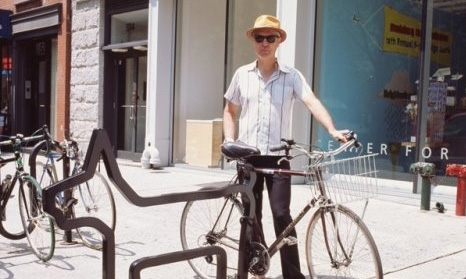
In that same issue of The New York Times (just a few inches above “Running from the City”), Malu Byrne’s father, rock star and bicycle enthusiast David Byrne, contributed a glowing piece on New York’s new bike-share program, which spans 420 stations across the lower half of Manhattan, Long Island City and western Brooklyn.
“This simple form of transportation is about to make our city more livable, more human and better connected; New Yorkers are going to love the bike-share program; culturally and physically, our city is perfectly suited for it,” writed the older Byrne.
He has used this form of “self-propelled” transportation for decades in the city, since first moving here as a young college graduate. Back then he lived in “glorious squalor.”
“We spent most of our full, busy lives in bookshops, bars, tiny apartments and cheap ethnic restaurants. It was exciting and productive, but it wasn’t easy, and eventually we wanted life to be less of a constant struggle,” he writes.
The city has become his home and Byrne, now 60, plans on staying here.
So the question for him, and many who want to raise children and grow old in the city, becomes: how can the quality of life in the city be enhanced? Byrne suggests that additions such as this new bike share program are integral.
Was the father-daughter match-up more than a neat editorial decision? Indeed the strategic placement of these two articles reinforces the notion that a second unavoidable consequence of the movement away from city living, the first being a potential loss in industrial diversity, is an equally pressing environmental one: as it turns out, life in the city is one of the most environmentally efficient ways of living.
From an environmental perspective, moving to a smaller town or the suburbs is less than ideal, mainly because you immediately need a car to get around.
Author David Owen explains the counter intuitive reality of “urbanization”–and its unfounded reputation as the ostracized kid among his socially viable environmentalist peers – in his book Green Metropolis.
According to Owen, sustainable living is more difficult in “smaller, far-flung places” than dense cities because smaller towns nurtured by nature forgo the conveniences of urban areas, such as cheap public transportation, and are car-dependent.
“This idea – that city life is hopelessly demented and that the solution to urban problems is to spread out – has been with us ever since. It’s the motivation for building suburbs, and it’s still seductive; it’s why I live where I live,” Owen wrote. “But it’s also a prescription for strip malls and expressways and tremendous waste, and it’s the basis for the helter-skelter residential development which has turned out to be America’s true manifest destiny…the mindless conversation of undeveloped countryside into subdivisions and SUV clogged expressways” (24).
In fact, on an individual for individual basis, New Yorkers whose stilettos grace cement more often than poppy fields are kinder, if inadvertently, to the environment than those who enjoy the luxury of leafy trees and periwinkle skies. Per capita consumption, for example, “the average Vermonter consumes a third more electricity as the average New York City resident, has a larger carbon foot-print, and generates more solid waste, backyard compost bins notwithstanding” (14).
The take-away message is simple: “New Yorkers, individually, drive, pollute, consume, and throw away much less than do the average residents of the surrounding suburbs, exurbs, small towns, and farms, because the tightly circumscribed space in which they live creates efficiencies and reduces the possibilities for reckless consumption.” (8).
In this light, Glaeser’s commentary on the importance of economic diversification is all the more relevant. Greater industrial variation may hit two birds with one stone.
A more livable New York could call for fewer green-papered moneymen – and a greater number of white-toqued chefs, black-spectacled engineers, green rooftop farmers, iridescent artists, and colorless philosophers – all thriving in a more diverse economy.
Photo: treehugger.com