Our idea is to duplicate existing Percent for Art programs, which are currently part of the City’s budget process and the MTA’s budget process, and create a Percent for Climate program, which would utilize NYC’s tremendous cultural base for climate education.
The fund shall be financed by setting aside at least one percent of the funds allocated by the City for climate resilience infrastructure for citywide climate educational programs. Public climate education and preparation will be supported by an additional one percent set-aside of the budget for the Department of Cultural Affairs and 0.1% of the NYC Public Schools budget for programs delivered within those agencies. Draft language is below in this post.
For context, Rebuild by Design, a research organization, estimates the infrastructure cost for New York City to prepare for climate impacts at $387 billion.
The goal of Percent for Climate is to help New Yorkers understand and join in achieving the Paris Agreement timeline, reducing emissions by half every ten years, as shown by the C40 Cities “Deadline 2020” report.
This new funding mechanism can create public outreach at scale. Deliberative workshops for New Yorkers about the future of the city are one type of program that could be piloted and scaled up. Parallels are discussed below:
- France provides an example for a citizens’ assembly on climate change, accompanied by a documentary.
- There have been more than 300 citizens’ assemblies worldwide. Jean-Marc Jancovici, French climate expert, has initiated a new national citizens’ assembly beginning in Fall 2026 in advance of the French elections, and he explained why on national television.
- The University of California includes the creation of new public venues among their ten proposed solutions to climate change.
Cultural and educational institutions in New York can partner with Percent for Climate to share the message about our transition to a low carbon city. The future of the institutions within the city is tied to the health of the city itself.
We think this could be a powerful step towards addressing climate change through citizen education, which will begin to give politicians social permission for greater action.
New York City has a $2.29 trillion economy, and a population almost as large as Sweden. The existing or planned resilience infrastructure budgets in NYC already total in the billions, but lack matching public communications.
We’re building the sea walls and the city is planning for an increase in heat waves (which are doubling on a ten-year basis), but there’s no public discussion or explanation of why, or how residents of the city should plan. That work needs full time attention, in the same way the sea wall construction is funded and staffed. Civic education is as valuable for the city in the long term, because sea walls are temporary protection against one type of impact, while reducing the impacts of climate change and adapting to those we’ve already committed to is only possible with comprehensive public dialogue and consent. Sea walls have no protective value for the full range of other impacts of climate change that include: heat waves, wildfire smoke, crop failures, and global destabilization.
As New Yorkers become global leaders in shifting to low carbon lifestyles, the benefits will be felt by people everywhere on the planet, because New York is one of the most financially and culturally influential cities in the world. New York can be a crucial global leader, simply by meeting the goals of the Paris Agreement as shown by the C40 Cities group.
Compared to a ‘business as usual’ scenario, expanding communications, and achieving low emission policies, are far less costly choices and much more realistic than attempts at adapting to impacts from a high emission pathway.
One small step, creating a Percent for Climate program in New York City, drawing on at least one percent of the city’s resiliency infrastructure budget, could be a game changer, one that triggers a broader push to decarbonize the world at the rates necessary to achieve the Paris Agreement. The global benefits for people at risk around the world are enormous. Protecting New York simultaneously protects billions of people in vulnerable nations.
We are gathering support from climate experts who would like to participate:
Eric Holthaus, the widely-followed writer and meteorologist, says:
“I’d *love* to be involved in something like this. For NYC, or for anywhere.”
In conclusion: Percent for Climate would structurally guide the City to providing climate information, education and workshops, in proportion to the size of the city itself, in the same way Percent for Art provides ongoing public art funding. Social stability improves when people have a place to bring their fears and address them as a group, seeking the most rational solutions from among our options. The training from workshops would also provide preparation in advance of extreme events, allowing for a safer and more coordinated response.
Let’s take this step, and help New York City, full of some of the brightest, most vibrant people on the planet, begin to teach itself about climate change, the challenge that matters most to our future.
Draft language:
- “Climate resilience” means the ability of New York City to prepare for, respond to, and recover from the impacts of climate change, including but not limited to extreme weather events, sea level rise, and heatwaves.
- “Climate education” means the process of increasing the knowledge, attitudes, and behaviors of individuals, organizations, and communities related to climate change and its impacts, as well as the available solutions and opportunities.
- “Public deliberation” means the exchange of views, opinions, and information among members of the public, through dialogue, debate, or other forms of participation, on issues related to climate change and its impacts on New York City.
Section 2. Fund for climate education and public deliberation
- The New York City government shall establish a fund for climate education and public deliberation, to be administered by a designated agency or entity.
- The fund shall be financed by setting aside at least one percent of the funds allocated by the City for climate resilience infrastructure for citywide climate educational programs. Public climate education and preparation will be supported by an additional one percent set-aside of the budget for the Department of Cultural Affairs and 0.1% of the NYC Public Schools budget for programs delivered within those agencies. Draft language is below in this post.
- The fund shall be used exclusively for the development, implementation, and evaluation of programs, activities, and initiatives related to climate education and public deliberation, including but not limited to:
- Grants, scholarships, and fellowships for research, education, and training on climate change and its impacts.
- Public awareness campaigns, workshops, seminars, and conferences on climate change and its solutions.
- Public engagement and participation projects, such as citizen science, crowdsourcing, and community-based planning.
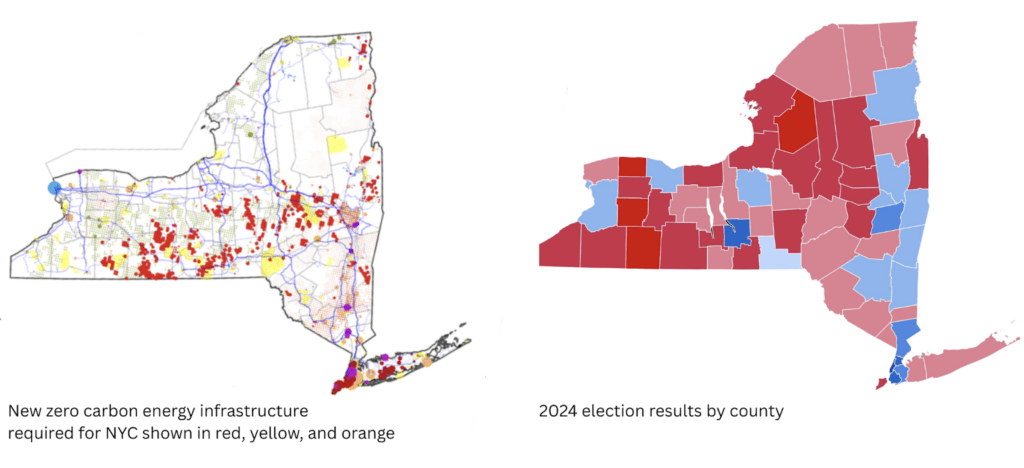
- Civic diplomatic outreach and mutual education with the public in Upstate New York and Long Island; New York City’s renewable power supply will largely be produced outside the five boroughs with the cooperation of voters in those areas. See figure below with projected geographic impact of infrastructure shown by the Vote Solar model side-by-side with the political map of New York State via New York Times 2024 election results.
- Evaluation and assessment of the effectiveness and impacts of climate education and public deliberation programs and initiatives.
- The designated agency or entity shall report annually to the city council on the status, accomplishments, and challenges of the fund, and make recommendations for its improvement and expansion.
____
Richard Reiss | richard@thecityatlas.org | newyork.thecityatlas.org
6 Comments
Comments are closed.